Boué Soeurs Genevieve Tobin Advertisement
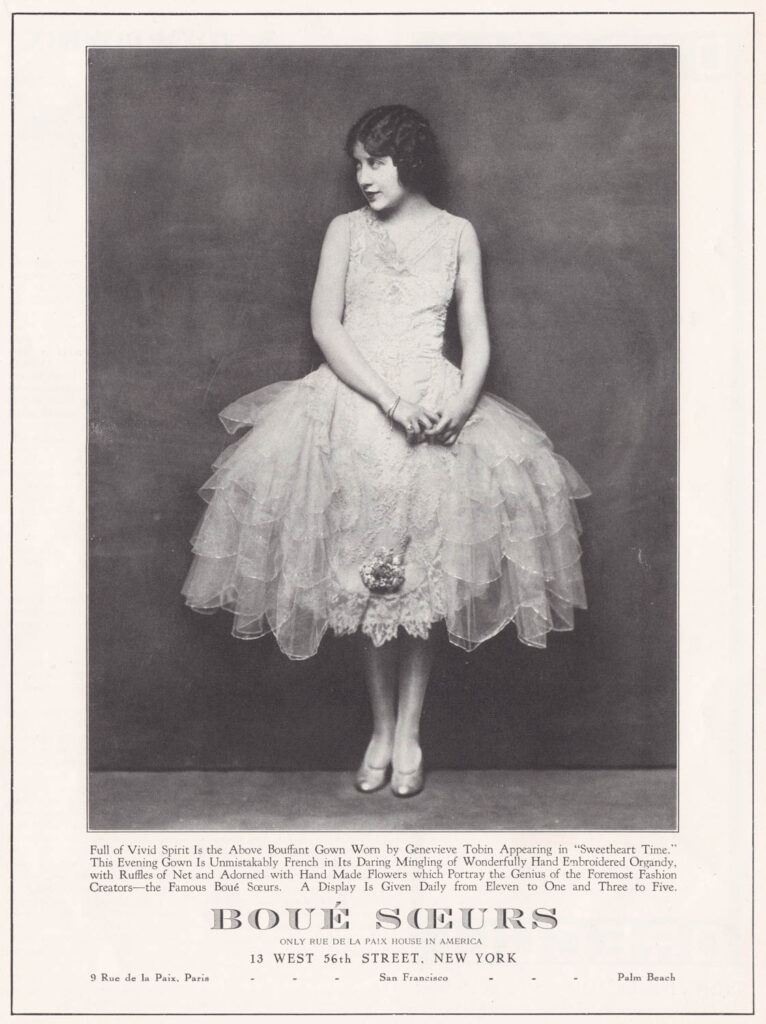
Date: c. 1926
Origin: USA
Brand: Boué Soeurs
This circa 1926 advertisement for Boué Soeurs depicts American stage and screen actress Genevieve Tobin (1899-1995), wearing a full-skirted, V-neck “bouffant gown” made of lace and “hand-embroidered organdy with ruffles of net” for the stage production Sweetheart Time. In February of 1926, Tobin joined the cast of this musical comedy stage production in New York City at the Imperial Theatre. This costume is adorned at the center hemline with handmade flowers, and the image’s minimal background reflects the aesthetics of popular fashion and film imagery of the period.
The Boué Soeurs couture house was founded in 1899 by sisters Madame Sylvie Montegut and Baronne Jeanne d’Etreillis. Based in Paris, the company operated from its headquarters at 9 Rue De La Paix. The design house became renowned for its feminine and elaborate creations, particularly its Robe De Style gowns, such as the one pictured in the advertisement. Signature details included whitework, metal embroidery, layered tulle, ribbonwork embellishments, and fine lace, techniques that overlapped with contemporary lingerie design.
The ‘Robe De Style’ is a style of dress that emerged during the 1920s, popularized by French couturier Jeanne Lanvin, for whom it became a signature design. Unlike the columnar, straight-cut “flapper” dresses most closely associated with the decade, the Robe De Style featured voluminous skirts, supported by petticoats, panniers, or hoop skirts, such as examples preserved in the collection of the Underpinnings Museum. Alongside Lanvin, other notable design houses producing this style included Lucile, Callot Soeurs, and Boué Soeurs. Boué Soeurs, in particular, became known for layered tulles and laces embellished with profuse ribbonwork, techniques that overlapped with contemporary lingerie design. A 1924 corset cover by Boué Soeurs in the collection of the Underpinnings Museum exemplifies this.
At the bottom of the advertisement, four locations are listed: Paris, San Francisco, Palm Beach, and 13 West 56th Street, New York. The brand proclaims itself the “Only Rue De La Paix House in America.” During the 1920s and 1930s, fashion increasingly felt the growing influence of Hollywood as the film industry matured into a dominant cultural and commercial force. Central to this shift was cinema’s ability to define contemporary ideals of style and glamour. This capitalizes on that influence in the American market by featuring a celebrated ingénue dressed in one of the house’s designs, becoming an advertisement for Boué Soeurs and Sweetheart Time.
From the collection of Karolina Laskowska.
Many thanks to Liv Elniski for the object description and research.
Museum number: KL-2024-004