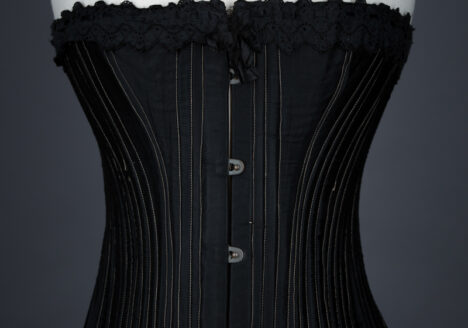
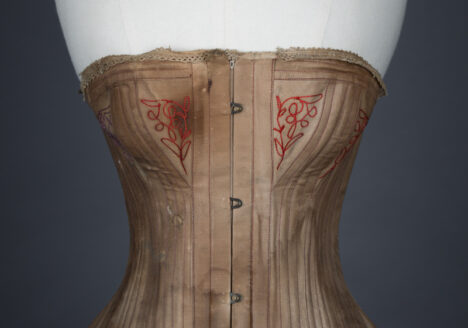
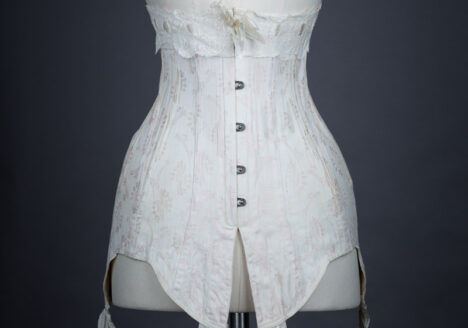
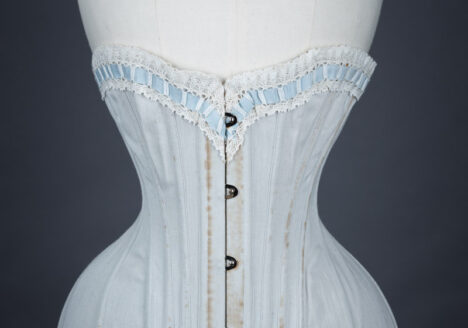
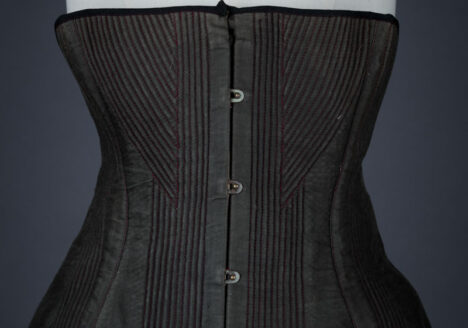
• Black cotton working woman's corset, c.1900, Great Britain. The Underpinnings Museum, Photo by Tigz Rice

    Black Cotton Heavily Boned Working Woman’s Corset

    Black Cotton Heavily Boned Working Woman's Corset Date:  c. 1900s Origin: Great Britain Fabric: Cotton Brand: Custom made   This corset was likely a working woman's corset, due to its gentle shape and numerous repairs and alterations. The body of the garment is constructed with an outer layer of sateen black cotton and an interior drab…
  • Brown cotton corset with embroidered bust gores, c. 1890s, USA From The Underpinnings Museum collection Photography by Tigz Rice

    Brown Cotton Corset With Embroidered Bust Gores

    Brown Cotton Corset With Embroidered Bust Gores Date:  c. 1890s Origin: United States Fabric: Cotton Brand: Custom made   This lightweight corset is created from two layers of cotton sateen and achieves its structure through gored patterning and a mix of narrow strips of baleen and flat steel bones, sandwiched in channels stitched into the two…
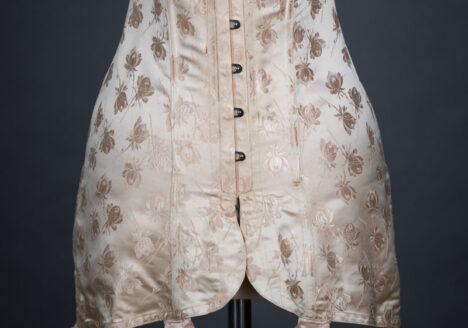
  • Floral Brocade Coutil Corset With Suspenders & Lace Trim By K&S, c. 1910s, Sweden. The Underpinnings Museum. Photography by Tigz Rice

    Floral Brocade Coutil Corset With Suspenders & Lace Trim By K&S

    Floral Brocade Coutil Corset With Suspenders & Lace Trim By K&S Date: c. 1910s Origin: Sweden Fabric: Floral brocade coutil Brand: K&S   This corset’s silhouette is typical of ‘Titanic era’ fashion, with a smooth flowing line and long line. It is lightly constructed, with a single layer of floral brocade coutil. The pattern is constructed from…
  • Grey herringbone coutil corset with ribbon slot lace trim, c. 1900-5, France. From The Underpinnings Museum collection. Photography by Tigz Rice.

    Grey Herringbone Coutil Midbust Corset With Ribbon Slot Lace Trim

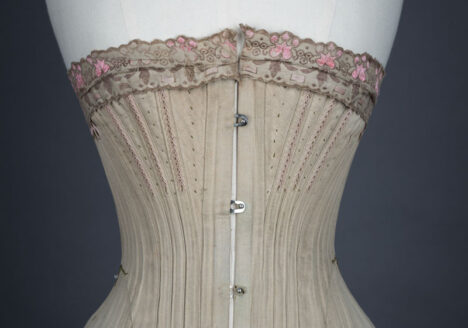
    Grey Herringbone Coutil Midbust Corset With Ribbon Slot Lace Trim Date:  c. 1900-5 Origin: France Fabric: Cotton coutil Brand: Unknown   This corset is most notable for how finely constructed and lightweight it is. Made from just a single layer of soft grey herringbone coutil, with only 4 panels per side. Support is achieved almost entirely with…
  • Cotton corset with cording and exposed spiral steel boning, c. 1900-5, Denmark. From The Underpinnings Museum collection. Photography by Tigz Rice

    Cotton Corset With Cording And Exposed Spiral Steel Boning

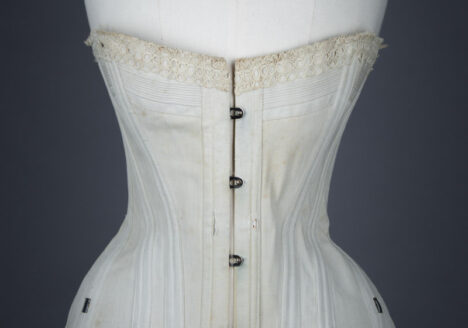
    Cotton Corset With Cording And Exposed Spiral Steel Boning Date:  c. 1900-5 Origin: Denmark Fabric: Cotton coutil Brand: Custom made   This midbust corset is constructed from a single layer of cream herringbone cotton coutil, with all panels vertically patterned. The garment is entirely supported with steel boning, with a combination of spiral steel wires and curved flat…
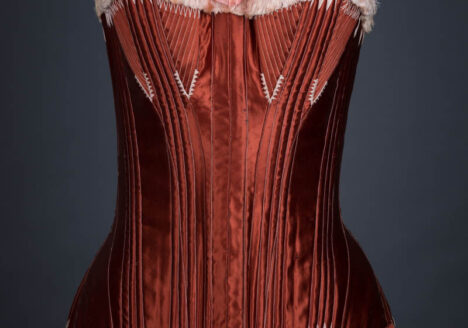
  • Red midbust corset with flossing and gores, c.1860s From The Underpinning Museum collection Photography by Tigz Rice

    Red Midbust Corset With Flossing Embroidery And Gores

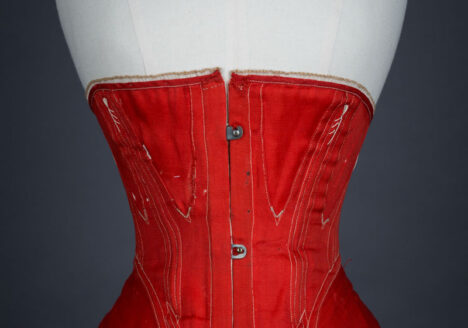
    Red Midbust Corset With Flossing Embroidery And Gores Date:  c. 1860s Origin: Great Britain Fabric: Wool and cotton Brand: Custom made   This corset boasts a typical 1860s silhouette, with its relatively short height (measuring just 29cm at the centre front), gored bust and hip pattern, and relative lack of structure. The corset is lightly boned…
  • Contrast stitched corded corset, c. 1860s, France From The Underpinnings Museum Collection Photography by Tigz Rice

    Contrast Stitching Corded Corset

    Contrast Stitching Corded Corset Date:  c. 1860s Origin: France Fabric: Cotton Brand: Custom made   This corset relies almost entirely on thick cording for its structure and support, which is applied in diagonals throughout the front of the corset. Stitching is in a contrast red to the exterior of the garment. The original outer fabric was likely…
  • 'Droit Devant Forme Nouvelle' Drab Coutil Corset With Flossing Embroidery, c, 1900-5, France. The Underpinnings Museum. Photography by Tigz Rice

    ‘Droit Devant Forme Nouvelle’ Drab Coutil Corset With Flossing Embroidery

    'Droit Devant Forme Nouvelle' Drab Coutil Corset With Flossing Embroidery Date:  c. 1900-5 Origin: France Fabric: Cotton coutil Brand: Unknown   This 'straight front' corset offers a typical silhouette of the early 1900s, marking the shift from curved and spoon busks to a more linear front line. It is constructed from two layers of drab herrinbone…
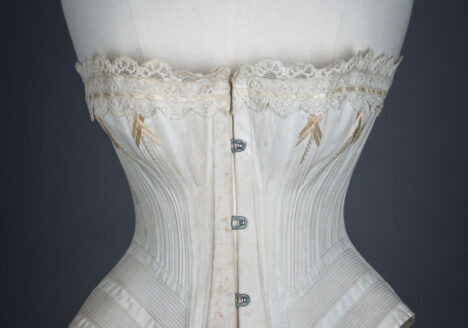
  • Corded corset with flossing embroidery by S&S, c. late 1880s, Great Britain From The Underpinnings Museum collection Photography by Tigz Rice

    Corded Corset With Flossing Embroidery By S&S

    Corded Corset With Flossing Embroidery By S&S Date:  c. late 1880s Origin: Great Britain Fabric: Cotton Brand: S&S   This lightweight yet very curvy corset is constructed from two layers of cream herringbone cotton coutil, and uses a variety of method to maintain its shape and supportive structures. Most support structures are encased within the two…
  • Silk maternity corset by La Huri, c. 1885, Spain. From The Underpinnings Museum collection Photography by Tigz Rice

    Silk Satin And Velvet Maternity Corset With Flossing Embroidery By La Huri

    Silk Satin And Velvet Maternity Corset With Flossing Embroidery By La Huri Date:  c. 1885 Origin: 39 Principe, Madrid, Spain Fabric: Silk Brand: La Huri   This corset was created to be worn during the course of pregnancy, with a number of design details that allowed this garment to adapt to a changing body shape…
  • Floral silk wedding corset by Lafayette, c. 1910s, France. The Underpinnings Museum. Photo by Tigz Rice

    Floral Silk Wedding Corset By Lafayette

    Floral Silk Wedding Corset By Lafayette Date: c.1910s Origin: France Fabric: Silk Brand: Lafayette   This corset's silhouette is typical of 'Titanic era' fashion, with a smooth flowing line and long line. It was likely intended to be part of a wedding trousseau, or as occasion wear, as it is very lightly constructed. The main body is…
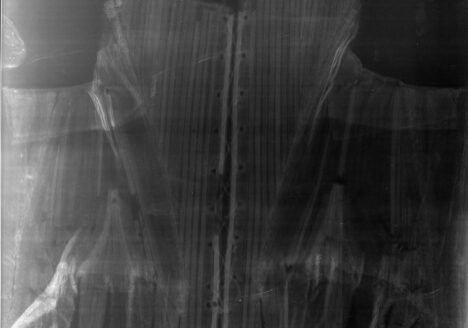
  • c. 18th century whaleboned stays, X-rayed in 2016, Austria Kindly donated by http://www.kurvendiskussionen.at/ From The Underpinnings Museum collection.

    Silk Brocade & Leather Stays X-Rays

    Silk Brocade & Leather Stays X-Rays Date: Stays c. 18th century, X-ray taken in 2016 Origin: Austria   These medical grade X-rays show the interior construction of a pair of 18th century stays. The stays are heavily boned throughout with baleen, with an interior metal support at the front fastening. The image indicates that some…