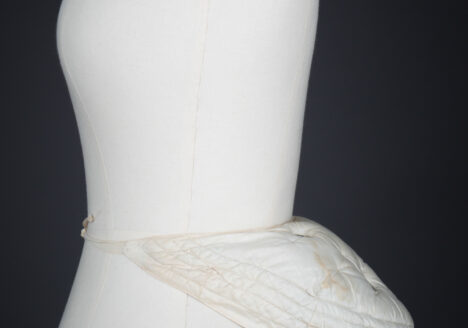
• 'The Scott' Ventilated Hip Pad & Bustle by Charles H. Scott, c. 1905, USA. The Underpinnings Museum. Photography by Tigz Rice.

    ‘The Scott’ Ventilated Hip Pad & Bustle by Charles H. Scott

    'The Scott' Ventilated Hip Pad & Bustle by Charles H. Scott Date: c. 1905 Origin: United States Fabric: Cotton Brand: Charles H. Scott   A bustle and hip pad designed to support the fashionable skirt shape of the 1900s. This pad fastens with a simple waist tie. A similar pad design was patented in 1903…
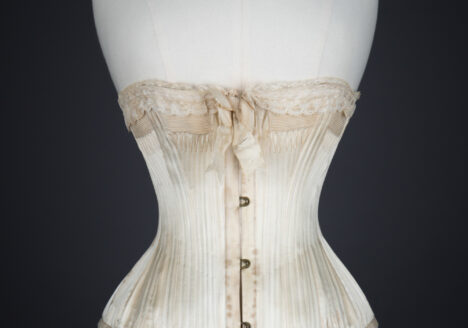
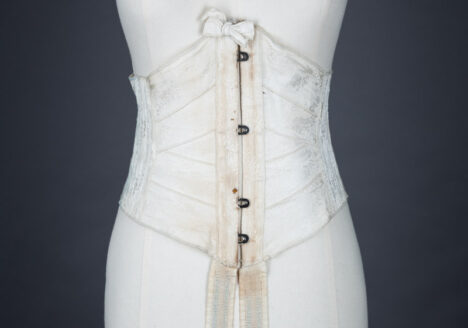
  • 'Stella' Ivory Satin Corset With Flossing Embroidery & Cording by C. T., c. 1900, made in France for the USA market. The Underpinnings Museum. Photography by Tigz Rice.

    ‘Stella’ Ivory Satin Corset With Flossing Embroidery & Cording by C. T.

    'Stella' Ivory Satin Corset With Flossing Embroidery & Cording by C. T. Date: c. 1900s Origin: Made in France for the USA market Fabric: Silk satin outer, cotton lining Brand: C. T.   A luxurious Parisian corset by 'C.T.', created for an American department store at 13th & Chestnut Street, Philadelphia. At the time it…
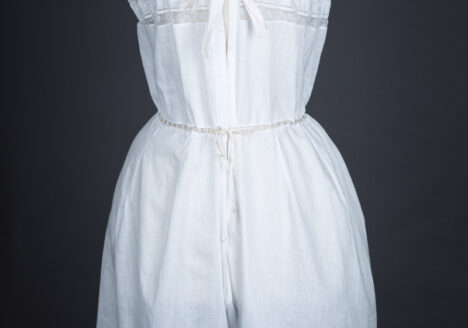
  • Split drawer step in with insertion lace and ribbonslot detail, c. 1900. The Underpinnings Museum shot by Tigz Rice Studios 2017

    Ribbon Slot & Insertion Lace White Cotton Step In

    Ribbon Slot & Insertion Lace White Cotton Step In Date:  c. 1900s Origin: Unknown. Possibly Great Britain Fabric: Cotton and lace Brand: Unknown, likely custom made   Combinations were a style of underwear popularised in the late 19th century, incorporating a camisole style bodice with split drawers, removing the need to wear a chemise and reducing the…
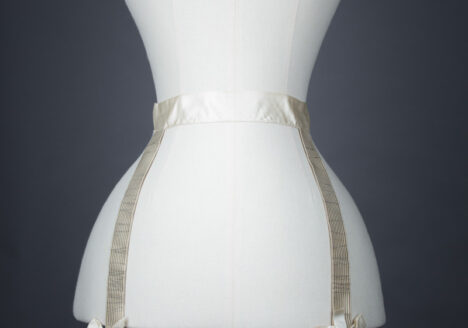
  • Cream Silk Hose Supporter Suspender Belt, c. 1900s. From The Underpinnings Museum collection Photography by Tigz Rice

    Cream Silk Hose Supporter Suspender Belt

    Cream Silk Hose Supporter Suspender Belt Date:  c.1900s Origin: Unknown Fabric: Silk and elastic Brand: Custom made   This early form of the suspender belt was likely intended to be worn over a corsetted waist. It has a waist band of folded silk ribbon that has been hand sewn with decorative stitches. Two strips of corded…
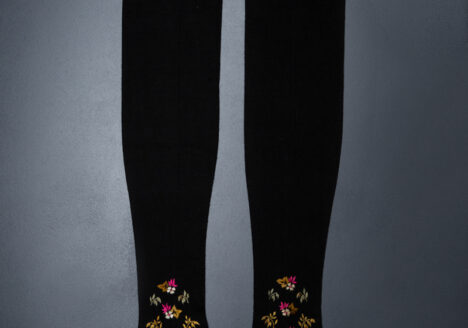
  • Floral Embroidered Black Silk Stockings, c. 1900, Great Britain From The Underpinnings Museum collection Photography by Tigz Rice

    Floral Embroidered Black Silk Stockings By Bourne & Hollingsworth

    Floral Embroidered Black Silk Stockings By Bourne & Hollingsworth Date: c. 1894-1902 Origin: London, Great Britain Fabric: Silk Brand: Bourne & Hollingsworth   Machine knitted silk stockings with profuse silk thread embroidery at the ankle. Stable and washable black dyes weren't invented until the second half of the 19th century and first began to appear in undergarments…
  • Overlocked Floral Jacquard Weave Ribbon Corset, c. 1900, Great Britain. The Underpinnings Museum. Photo by Tigz Rice

    Overlocked Floral Jacquard Weave Ribbon Corset

    Overlocked Floral Jacquard Weave Ribbon Corset Date:  c. 1900s Origin: Great Britain Fabric: Jacquard weave cotton Brand: Unknown Ribbon corsets began to appear at the turn of the century and offered women a much greater freedom of movement than traditional corset styles. The cut was much less restrictive, constricting only a small portion of the waist…
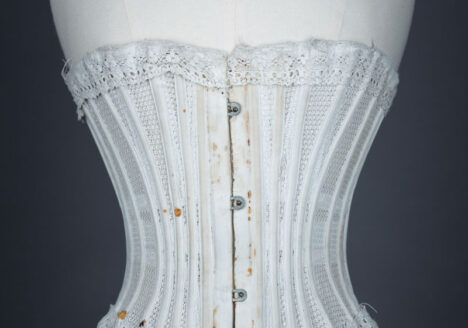
  • 'Langdon & Batcheller's Genuine Thomson's Glove Fitting' Corset, 'Made of English Netting', c. 1902, USA. The Underpinnings Museum. Photography by Tigz Rice

    ‘Langdon Batcheller’s Genuine Thomson’s Glove Fitting’ Corset, ‘Made of English Netting’

    'Langdon Batcheller's Genuine Thomson's Glove Fitting' Corset, 'Made of English Netting' Date:  c. 1902 Origin: United States Fabric: Cotton bobbinet tulle, 'English netting' Brand: Langdon Batcheller's Genuine Thomson's Glove Fitting The incredibly lightweight construction of this corset suggests that it was intended for wear in hot or humid climates. The single layer of 'English net' (a…
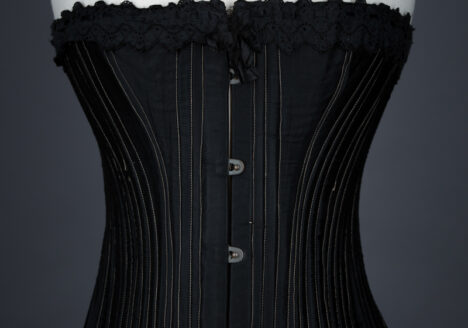
  • Black cotton working woman's corset, c.1900, Great Britain. The Underpinnings Museum, Photo by Tigz Rice

    Black Cotton Heavily Boned Working Woman’s Corset

    Black Cotton Heavily Boned Working Woman's Corset Date:  c. 1900s Origin: Great Britain Fabric: Cotton Brand: Custom made   This corset was likely a working woman's corset, due to its gentle shape and numerous repairs and alterations. The body of the garment is constructed with an outer layer of sateen black cotton and an interior drab…
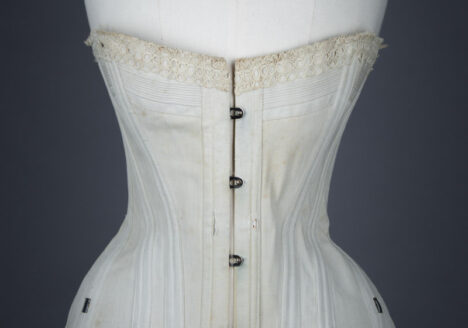
  • Grey herringbone coutil corset with ribbon slot lace trim, c. 1900-5, France. From The Underpinnings Museum collection. Photography by Tigz Rice.

    Grey Herringbone Coutil Midbust Corset With Ribbon Slot Lace Trim

    Grey Herringbone Coutil Midbust Corset With Ribbon Slot Lace Trim Date:  c. 1900-5 Origin: France Fabric: Cotton coutil Brand: Unknown   This corset is most notable for how finely constructed and lightweight it is. Made from just a single layer of soft grey herringbone coutil, with only 4 panels per side. Support is achieved almost entirely with…
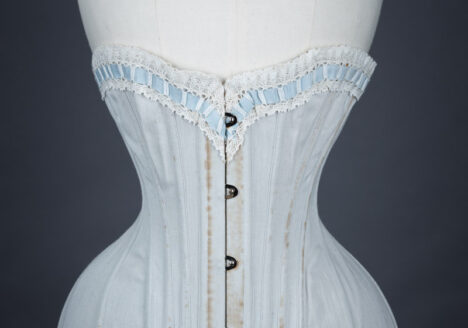
  • Cotton corset with cording and exposed spiral steel boning, c. 1900-5, Denmark. From The Underpinnings Museum collection. Photography by Tigz Rice

    Cotton Corset With Cording And Exposed Spiral Steel Boning

    Cotton Corset With Cording And Exposed Spiral Steel Boning Date:  c. 1900-5 Origin: Denmark Fabric: Cotton coutil Brand: Custom made   This midbust corset is constructed from a single layer of cream herringbone cotton coutil, with all panels vertically patterned. The garment is entirely supported with steel boning, with a combination of spiral steel wires and curved flat…
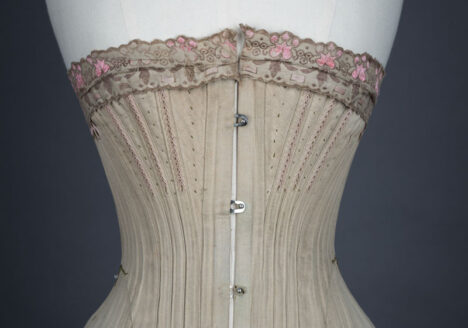
  • 'Droit Devant Forme Nouvelle' Drab Coutil Corset With Flossing Embroidery, c, 1900-5, France. The Underpinnings Museum. Photography by Tigz Rice

    ‘Droit Devant Forme Nouvelle’ Drab Coutil Corset With Flossing Embroidery

    'Droit Devant Forme Nouvelle' Drab Coutil Corset With Flossing Embroidery Date:  c. 1900-5 Origin: France Fabric: Cotton coutil Brand: Unknown   This 'straight front' corset offers a typical silhouette of the early 1900s, marking the shift from curved and spoon busks to a more linear front line. It is constructed from two layers of drab herrinbone…
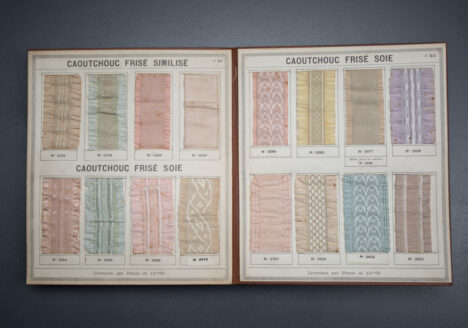
  • 'Lacets Et Tissus Elastiques No 23' Elastic Trim Catalogue, c. 1900s, France Photography by Tigz Rice Studios From The Underpinnings Museum collection

    ‘Lacets Et Tissus Elastiques No 23’ Elastic Trim Catalogue

    'Lacets Et Tissus Elastiques No 23' Elastic Trim Catalogue Date:  c.1900s Origin: France Fabric: Elastics Brand: Unknown     A sample book of various elastic trims c. 1900. Elastication was still a relatively new technology, and these trim options offered makers of all varieties of clothing exciting possibilities. The book boasts a number of plain elastics, as well as…